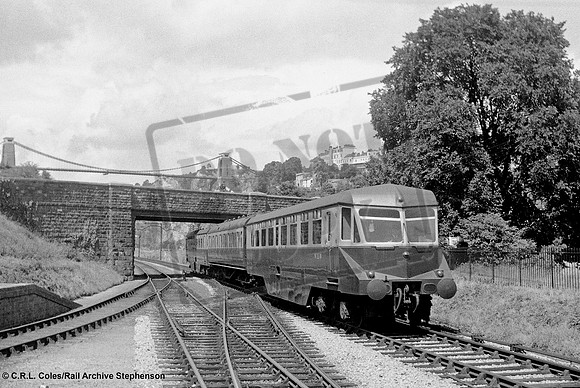
W35W 1953-06 Clifton
GWR diesel railcar No W35W leads a Portishead to Bristol train arriving at Clifton Bridge in June 1953.
Peter Kerslake says "Bristol St Philips Marsh Depot at which there must have been refuelling facilities from an early date, received its first of the former G.W.R. Railcars in 1940 and put them to work on the Portihead branch, as seen here, in addition to working them through the Severn Tunnel to Newport and Cardiff as well as rostering them on services to Bath with the last at that Depot being W28W, transferred to Bath Road probably from Weymouth, and W25W which remained there until May of 1962.
W35W seen here with doubtless her sister unit W36W at the trailing end were two of the last four units completed in 1940 and 1941, fitted with buffet accomodation and intended to run in pairs with their combined power output of 420 h.p. being enough for them to operate with a 70 foot corridor coach marshalled between them as seen here.
Sadly W35W and W36W were destroyed by fire at St. Anne's Park on the main line from Temple Meads whilst on a Bath working on the 10th April 1957.
With Mr Brunel's bridge in the background the Railcars are heading through Clifton Bridge station on their way from Portishead to Ashton Gate and Temple Meads, the line dating back to the broad gauge days of 1867 and with passenger services lasting until September of 1964 although freight services still continue today
With the elegant Regency mansions at Clifton high on the skyline and with Mr. Brunel's masterpiece also seen in this fine view Clifton Down was the largest station on the Portishead branch line from Temple Meads and the line on the left leads into a small siding capable of holding an empty coach or two plus some horse boxes , their steeds doubtless being used in the nearby Ashton Court estate.
Sold to the Great Western in 1883 the line gained in importance in 1927 with the advent of Portishead's first power station followed by a second such station in the mid ' forties , but despite Portishead's rapid commuter expansion in the early sixties passenger services ended in September of 1964 , and the station here was demolished to make way for Police Dogs and Mounted Section Headquarters although freight services from Portbury still operate on the line"
Photo: C.R.L. Coles/Rail Archive Stephenson