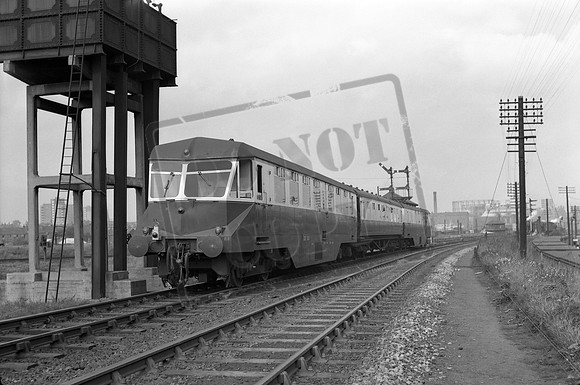
W33W W38W 1955-10-02 Birmingham Landor Street
This most remarkable sight was in 1955 when a three car GWR railcar set travelled with a group of Nat West Bank railway enthusiasts from Paddington to Derby via Birmingham. The last four Great Western railcars were operated as twin-coupled railcar units, the forerunner of today’s diesel multiple units. With the driving compartments only at the outer ends of the set, buffet and toilet facilities could be provided for 104 seated passengers, and if a standard corridor coach was added between the two cars, another 70 seats could be added, allowing them to be used on longer-distance workings such as Birmingham to Cardiff. The units, which were built in 1941/2, were identical in technical details to the single car, Nos.19 - 33, series. This set pictured at Landor Street. They were used at this time on enthusiast specials such as one organised by the Birmingham Locomotive Club to Buxton and a Talyllyn Railway Preservation Society AGM working. The water tower supplied the water columns at Lawley Street Goods Station. The center car was W1096W and was, of course, specially adapted to work as the center of the 3 car set. It was for a proposed fast express passenger service between Cardiff and Birmingham that the Great Western had introduced three of these Railcars in 1934 , those examples having an onboard buffet service together with toilet facilities , but that service proved too popular for the seventy seat accommodation of the Railcars , which were subsequently replaced by steam hauled conventional stock. W33W and W38W seen here also had buffet and toilet facilities and were intended from the outset to be used as a twin or three coach unit as shown here. There were many variations in detail design in the class , which totalled 35 remaining in service in January of 1956 , those survivors being in wide use throughout the Western Region , and allocated to no less than thirteen Depots at that period in time , ranging from Bristol and Weymouth to Southall , Reading , Worcester and South Wales.