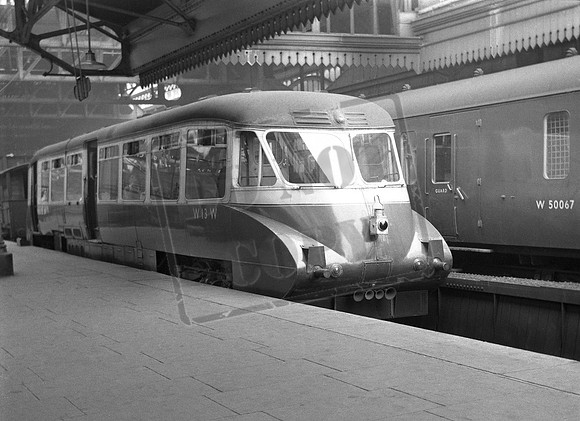
W13W 1960c Birmingham Snow Hill
This railcar was withdrawn in August 1960. Nice detail of the front end showing the four horns and the absence of conventional drawgear and buffers. Those Railcars with the rounded and smoothed front ends certainly looked more handsome than some of their counterparts with their sharply wedged shaped design , and W13W seen here at Snow Hill makes a fine picture . Built in 1936 this particular unit , in company with the earlier versions and four later ones , had its original single power unit producing 121 h.p. replaced by twin A.E.C. engines thereby doubling the power output , whilst the later versions had a 210 horse power output. There were many variants in design , and the Railcars saw service throughout the Western Region network , the last survivors remaining in service until 1962 , with W22W being saved from Barry , going initially to the Severn Valley Railway from where it was later moved to Didcot in 1967.
Peter Kerslake adds "Railcar number 13 seen here at Birmingham Snow Hill is doubtless on a service from Cardiff , this unit being the sole member of her class at Cardiff Canton in the years preceding this image , and reviving memories of the services between those two Cities commenced in 1934 by the second , third and fourth Railcars with bodywork by Park Royal proving so popular that they exceeded the expectations of the Great Western and had to be replaced by conventional steam worked services with increased seating capacity.
Early examples up to and including Railcar number 17 were powered by a single A.E.C. Diesel, producing 121 h.p. , whilst later versions had a second such engine fitted therby doubling their power output.
Note the array of air horns, very necessary as these units were quiet when running, a feature not always appreciated by maintenance gangs whilst working on the tracks!"