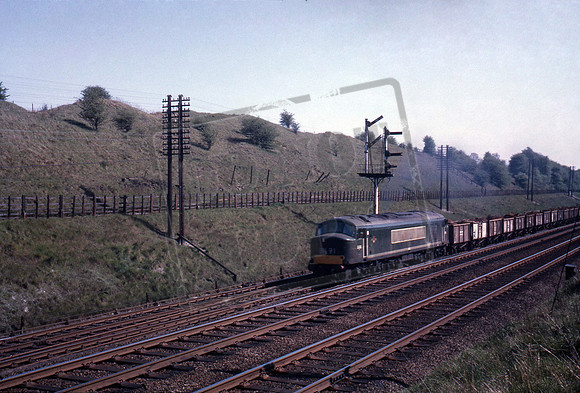
D38 1967c Glendon
With an Iron Ore trip from the quarries to Corby or it may have come from further afield, the code is 8M91. The M headcode in the 1970s meant a train originating from another region destinmed for the LMR. The train is clearly loaded and the only place I can think of South of Glendon mining Iron ore was the Oxfordshire area, which closed in 1967 but was it sending Iron Ore to Corby (assuming that is indeed where it is bound for)?
David J Hayes has been looking into these codes with regards to the "M" headcodes for these iron-ore workings and says "You may well be correct that these were indeed the codes used back then for trains to and from Corby, although, as I said before, Corby Steelworks had its own extensive ironstone operations close by, though this is not to say that the works didn't receive the mineral from elsewhere. My only other theory is that the iron-ore trains originated at Kettering/Wellingborough and terminated somewhere else on the London Midland, but ventured through Eastern Region territory en-route to get there, which would again rule out Corby as the destination but explain the use of the inter-regional headcode "M" in both directions. For example, there used to be a cement train from Earle Sidings to Handsworth (Birmingham), which ran with an inter-regional "M" headcode in both directions (loaded and empty) because it briefly traversed Eastern Region metals around the Chesterfield area.
An interesting article in Railway Magazine (Jan 1970) about iron-ore/iron concentrate traffic generated in the Wellingborough area during the latter half of the 1960s may also explain the use of the inter-regional "M" headcode and support my theory. The article mentions iron-ore workings to the North East (Cargo Fleet, Hartlepool and South Bank) during this period. Some of these called additionally at Kettering and Oakham to to attach iron-ore traffic. The return workings would've no doubt ran with an "M" headcode. There was also a movement of iron concentrate (see below) to Lancashire (Irlam) and North Staffordshire (Etruria). Those to Lancashire may well have travelled via Chesterfield and/or the Woodhead route, and therefore traversed Eastern Region metals (as would the returning empties, presumably?). However, there's no mention of trains to Corby in the article.
You mention about the Oxfordshire ironstone operation. The Oxfordshire Ironstone Company (OIC) operations was wound down in September 1967. These were once the second largest ironstone workings in the Midlands after those to be found at Corby. Trains from the OIC ran to steelworks in South Wales and to Bilston Steelworks (Spring Vale) in the Black Country region of the West Midlands. During the 1970s, Bilston Steelworks was served by a regular "iron-ore" train from Wellingborough conveying a ferruginous gravel/iron concentrate, which was a by-product of the sand and gravel quarrying operations of the Nene Valley (it was loaded onto rail at Higham Ferrers until that branch lines closure in 1969). The iron concentrate had a higher iron yield to that of the traditional iron-ores and was thus favoured by the steel industry. The same mineral was also conveyed from Wellingborough to Wrexham for Brymbo Steelworks. Bilston Steelworks was also served by traditional iron-ore trains from Corby (like Corby, Bilston's Spring Vale Steelworks was owned by Stewarts & Lloyds before nationalization)."