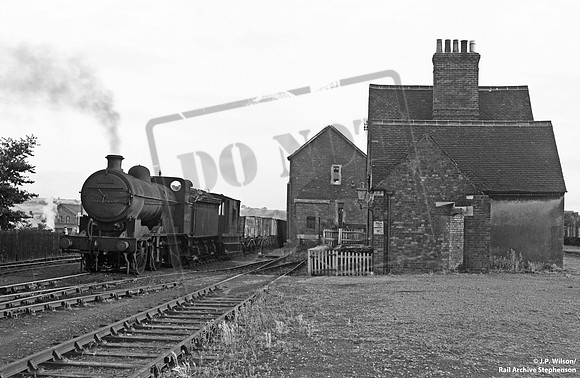
64227 1953-08-18 Earle's Field station, Grantham
GNR J6 0-6-0 No 64277 shunting at Earle's Field station, Grantham on 18 August 1953. John Clayson explains- "This is Grantham’s first railway station, the former terminus of the Ambergate, Nottingham and Boston and Eastern Junction Railway which opened between Nottingham and the canal basin and wharf at Grantham in 1850 (though it never expanded further to reach either Ambergate or Boston!). In 1852 it was superseded by the GNR’s station on the newly constructed ‘Towns Line’ and it lost its status as a passenger station. It became a goods and mineral (mainly coal) yard known as the Ambergate Yard, accessed latterly by a branch from a junction with the Nottingham branch at Barrowby Road signal box. The local gas works received its supplies of coal via the branch (formerly via the canal), and the surrounding area became quite intensively industrialised during the 19th century.This is Grantham’s first railway station, the former terminus of the Ambergate, Nottingham and Boston and Eastern Junction Railway which opened between Nottingham and the canal basin and wharf at Grantham in 1850 (though it never expanded further to reach either Ambergate or Boston!). In 1852 it was superseded by the GNR’s station on the newly constructed ‘Towns Line’ and it lost its status as a passenger station. It became a goods and mineral (mainly coal) yard known as the Ambergate Yard, accessed latterly by a branch from a junction with the Nottingham branch at Barrowby Road signal box. The local gas works received its supplies of coal via the branch (formerly via the canal), and the surrounding area became quite intensively industrialised during the 19th century. The 1850 station was situated in a locality known as Earle’s Fields (today there’s still an Earlesfield Lane), but we aren’t aware that it was ever commonly referred to as the Earle’s Fields station.
Photo: J.P. Wilson / Rail Archive Stephenson