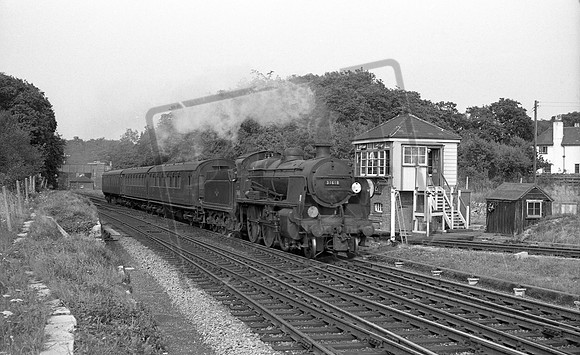
31618 1962-07-28 Lymington Jct
On a Southampton-Bournemouth working
Peter Swift has all the details "The photograph shows U class No. 31618 passing Lymington Junction on a down working. I was going to say at first glance the date was circa 1963, however I’ve now seen there is a date of 28 July 1962 on the photo title, so I wasn’t far out! Due to the short formation off the train I suggest it could be on a Southampton to Bournemouth stopping service.
It is heading west taking the Bournemouth Direct line which was opened by the LSWR in March 1888, whereas the junction point-work for the earlier Southampton & Dorchester Railway (S&DR) line to Dorchester (opened June 1847) is seen in the foreground diverging off to the viewers left. The section of line from this point through to Ringwood closing to all traffic in May 1964. The single line between the train and the signal box is the Lymington branch which opened in July 1858, and remains open to this day. The signal box and junction were abolished in October 1978 when a new single track extending from Brockenhurst, running parallel to the twin-track main line, was brought in to use solely for use by Lymington branch trains. The signal box is a LSWR type 3a design brought into use as from 18th July 1915. This replaced an earlier box which is recorded as being opened c.1872. The Ordnance Survey 1/2500 map revised in 1896 suggests it is the building seen in the background, in front of the bridge. However, this structure is of a style that suggest this maybe the original S&DR gatekeepers lodge No.9 which definitely became redundant for this purpose when the crossing was closed with the construction of the road overbridge c.1893, or possibly even earlier with the introduction of the first signal box. Possibly the gatekeepers lodge was converted for use as the first signal box, as a few others along the line were?
The locomotive is one of the rebuilt ‘K’ class 2-6-4 tanks. Though the SECR Directors approved the construction of six of these locomotives in 1915 it was not until June 1917 that the first (No.790) of the class appeared, whilst others in this batch had to wait until 1925 before they in turn were also constructed by which time the order had increased to 10 locomotives. By this time it was Southern Railway policy to name its new passenger locomotives; this class being named after rivers flowing through SR territory thus earning the moniker of ‘River’ class. Another batch of 10 followed in 1926, whilst No. A618 (River Hamble had been its allotted name) was one of a last batch of twenty engines ordered in March 1926. However, before these were completed No. A800 River Cray derailed at speed approaching Sevenoaks in August 1927, and following bad Press the whole class was immediately withdrawn from service. After trials it was agreed to rebuild them as tender locomotives and re-classified as ‘U’ class, this included the last batch of ‘Rivers’ which were altered to tender locomotives before entering service in 1928/1929. Therefore, A618 entered service as a 2-6-0 tender locomotive with no name in October 1928 having been erected at Brighton Works. It was finally withdrawn in January 1964. Luckily it was one of four of the ‘U’ class sold to Woodhams Brothers at Barry, thus permitting its purchase by the Southern Mogul Preservation Fund in January 1968 and now resides at the Bluebell Railway.
As for the carriages – the leading pair are an ex-LSWR designed ‘Ironclad’ 2-set consisting of a Brake Third coupled to a Brake Composite. This is one of five sets (381 – 385) that were not constructed until SR days entering service in late 1925 / early 1926, and by this date were not paired with the normal 9’ double-framed bogies associated with these carriages but instead were fitted with Ashford inspired 9’ bogies that were similar in appearance to what became the standard 8’ bogies fitted to SR stock. The Southern had originally intended them to be built at the ex-LBSCR carriage works at Lancing but for whatever reason were actually built at their traditional home of Eastleigh. Commencing in October 1948 four of these sets (381-384) were converted for push-pull workings (set 385 following in March 1952) which involved the gangways being removed, the lavatories being converted to a coupé, and a driving end fitted to the guards end of the Brake Third. In this guise they remained in service on ex-LSWR branches in Devon, Dorset and Hampshire until finally being withdrawn in late 1962.
The trailing coach I can’t identify but to my eyes appears to be a BR Mark 1 of some description.