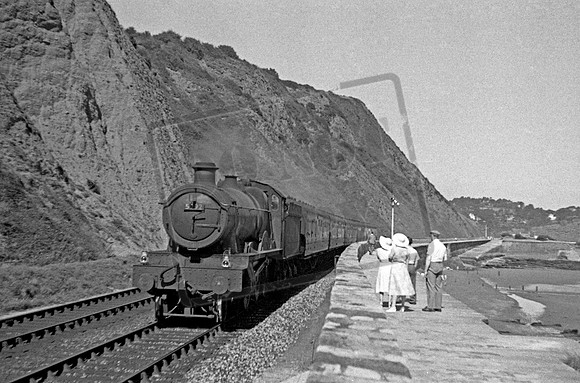
5992 1954-08-31 Teignmouth
What is recorded as the Down 'Cornishman' express approaching Teignmouth along the sea-wall looking towards Dawlish - where you could if you liked watch trains and enjoy the seaside at the same time: the footpath follows the railway closely, except where the railway had to pierce the headlands through five short tunnels. Here the (well-dressed) holiday-makers take only a casual interest, in contrast to the excitement shown nowadays when a steam engine passes.
We think this is unlikely to be the "Cornishman" as the load is only five coaches although it could be a relief. The 'Cornishman' left Wolverhampton (Low Level) at 09.00 and ran via Birmingham (Snow Hill), Stratford-on-Avon, Cheltenham (Malvern Road), Bristol (Temple Meads - avoided on Saturdays), Taunton and Exeter (St David's) to Penzance, depositing a portion at Newton Abbot for Kingswear, although in high season this ran separately - which is the train seen here, with 4-6-0 No. 5992 'Horton Hall' (built 12/39, withdrawn 8/65). In the summer there were also through coaches to Newquay, running on Saturdays as a separate train.
Peter Kerslake adds "A bit more information to add to the very full notes already shown in that 5992 "Horton Hall" was shown to have been a Taunton engine in the mid 'fifties and if that is so at the date of this view there is a strong possibility that the rostered and customary "Castle" so familiar on the down "Cornishman" may have failed, as the use of just a "Hall" is most unusual and the "Cornishman" Headboard is missing as well.
My memory is that the engine on the down "Cornishman" was invariably a Bristol Bath Road, or Newton Abbot "Castle" which did not come off at Plymouth as was the usual practice but worked right through from Temple Meads to Penzance, invariably returning the following day on the northbound "Cornishman".
Sprey Point can be seen in this view on the right, constructed by Mr. Brunel in 1839 when he tidied up and walled round a massive rock fall rather than clear the rocks which had fallen from the cliffs above during his construction of the line."