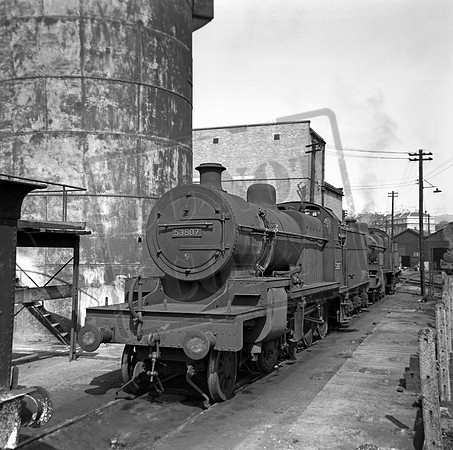
53807 19658 Bath Green Park
The new code 82F, after the Feb re-shuffle, is painted on the smokebox door
Peter Kerslake says "A fine picture of what was destined to be the last of her class to remain in service upon her withdrawal in September of 1964, and on her home shed at Bath Green Park, 53807 is seen here with a sister engine behind resting from their duties on the famous Somerset and Dorset line.
Initially introduced by Sir Henry Fowler in 1914 in order to fill a gap in the number of heavy freight locomotives on the Midland Railway , and designed especially with the Somerset and Dorset line's heavy mineral traffic in mind the original six of the class were built at Derby, with an additional five more coming from Robert Stephensons in 1925.
Summer Saturdays in the 'fifties and 'sixties and an increased popularity of the direct line from the Midlands to and from the South Coast brought an increase in holiday passenger traffic to the Somerset and Dorset, and members of the class were used to advantage on both advertised and additional workings between Bath and Bournemouth until this engine, the last survivor of her class , was condemned in September of 1964 with the line closing two years later.
Happily, 53808 and 53809 have survived into preservation.
Well captured on film in 1958 two of the Fowler "7F's" are at rest on the former Midland Railway section of Bath Green Park M.P.D., with the shed buildings visible in the background.
Although looking in need of attention from the cleaning gang 53807 and her sisters were the mainstay of both passenger and freight workings during their long lives on the Somerset and Dorset, the class having been built from 1914 specifically for such duties by the Midland Railway, then responsible for running the line across the Mendips.
Additional and heavily loaded long distance passenger workings in the years when the line was such a vital link between the North of England and the Bournemouth coastal areas tested the "7F's to the full, and double heading of such services was the norm, particularly during the Summer Timetables up to, and including 1962 when such through workings came to an end.